Sunday, July 15, 2012

New York's High Line: An Urban Wonder

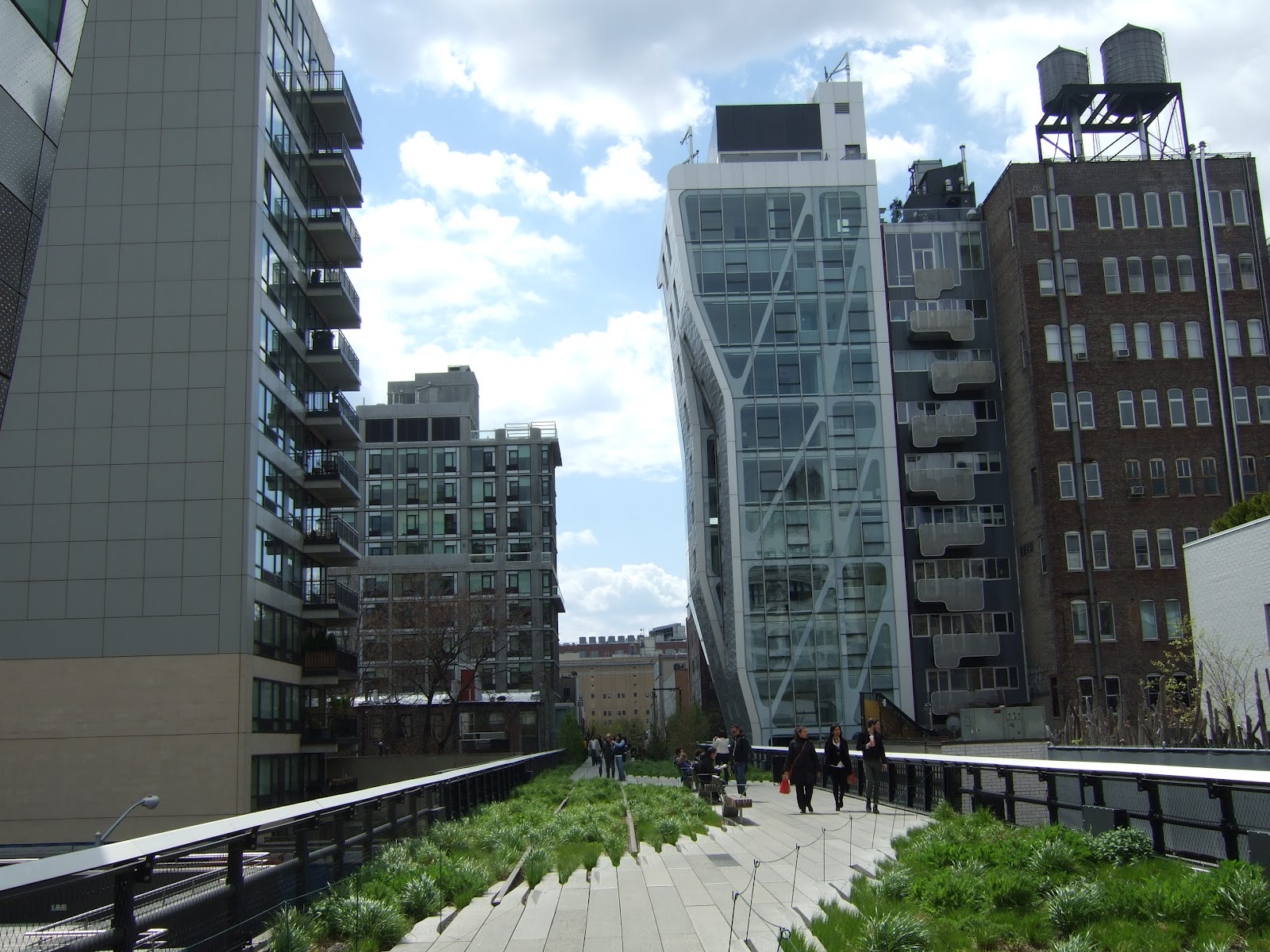
I recently had the opportunity to visit New York's High Line urban park.  Converted train tracks, paved over and bracketed with flower beds and artwork, offer stunning views of a former industrial part of New York.  Here are a few photographs I snapped:


Saturday, July 16, 2011

A Physics Walking Tour of Washington D.C.

A Physics Walking Tour of Washington, DC
By Paul Halpern

Excerpted from “Washington: A DC Circuit Tour,” P. Halpern, Physics in Perspective 12, No. 4, (2010), pp. 443-466. All photos by Aden Halpern and Paul Halpern, except for the photo of the historic Van de Graaff generator at the Department of Terrestrial Magnetism, used by permission of the Carnegie Institution of Washington.

Stop 1: Joseph Henry Statue
We start our walk at the statue of Joseph Henry located in the National Mall directly in front of the “castle” housing the headquarters of the Smithsonian Institution (Smithsonian Metro Station). Designed by William Wetmore Story, the statue was dedicated in 1883. A widely accomplished physicist, Henry served as the first Secretary of the Smithsonian Institution.


Stop 2: The Smithsonian Building
We now walk from the Henry statue to the castle-like edifice behind it, the Smithsonian Building, completed in 1855. On the south side of the Smithsonian Building is an area known as the South Yard where, from 1890 to 1955, a shed housed the Smithsonian Astrophysical Observatory, one of the first centers in the world for astrophysical research.


Stop 3: U.S. Department of Energy
Across Independence Avenue from the Smithsonian’s South Yard is the Forrestal Building, which was built in 1970 and today houses the U.S. Department of Energy.

Stop 4: The Continuum Sculpture and the National Air and Space Museum
Going east along Independence Aveue and crossing 7th Street SW, we see on our left the National Air and Space Museum. Directly in front of its entrance is the modern sculpture Continuum, which was commissioned in 1976 and designed by artist Charles O. Perry to represent a distorted region of spacetime in the vicinity of a black hole.


Stop 5: Koshland Science Museum
Crossing the National Mall and walking due north several blocks along 6th Street NW, we arrive at the corner of E Street and find ourselves at the entrance of the Marion Koshland Science Museum of the National Academy of Sciences, which specializes in contemporary scientific issues.

Stop 6: National Museum of American History
Walking six blocks west along E Street, and then the equivalent of three blocks south along 12th Street NW, we arrive at Constitution Avenue and see on the other side of it the entrance to the National Museum of American History (Federal Triangle Metro Station). Long a part of the Smithsonian, it has two significant collections on physics: the Physical Sciences Collection and the Modern Physics Collection.

Stop 7: Albert Einstein Memorial and the National Academy of Sciences
We exit the National Museum of American History and walk eight blocks west on Constitution Avenue, cross 21st Street NW, and see the Albert Einstein Memorial in a shady grove in front of the National Academy of Sciences. It features a 12-foot bronze statue of Einstein, weighing about 4 tons, that was sculpted by Robert Berks to depict the founder of relativity in his later years.


Stop 8: Corcoran Hall: George Washington University
We now stroll the equivalent of about four blocks north on 21st Street NW, cross G Street, and reach Corcoran Hall, home of the Department of Physics of George Washington University since 1924.. GWU’s Department of Physics rose to prominence internationally with the appointment of Russian physicist George Gamow in 1934 and of Hungarian physicist Edward Teller in 1935. Plaques honoring Gamow and Teller, along with the Fifth Washington Conference on Theoretical Physics are featured on the wall facing 21st Street. At that conference, which took place at GWU in 1939, Niels Bohr announced to the astonished participants the discovery of nuclear fission in Germany.


Stop 9: Carnegie Institution of Washington
We now leave GWU and stroll seven blocks north along 21st Street NW to P Street. Then we turn right and go five blocks east to the corner of 16th Street NW and P Street where the Carnegie Institution of Washington (also known as the Carnegie Institution for Science) is situated (Dupont Circle Metro Station). Its three divisions with the deepest connections to physics are the Observatories Department (originally just Mount Wilson Observatory), the Department of Terrestrial Magnetism, and the Geophysical Laboratory.


The Carnegie Institution’s Department of Terrestrial Magnetism, founded in 1904 under the directorship of American physicist Louis Agricola Bauer, is housed in separate quarters at 5241 Broad Branch Road NW in the leafy northwestern corner of the District. It includes a pioneering Van de Graaff accelerator, completed in 1933 by physicist Merle Tuve, and used to explore the realm of the nucleus.


The Geophysical Laboratory was founded in 1905 and was located on Upton Street NW before it was relocated to the Broad Branch Road campus near the DTM in 1990. (Mt. Wilson Observatory is in California and not included on this walking tour except for the very athletic.)

Stop 10: Oak Hill Cemetery in Georgetown
From the main headquarters of the Carnegie Institution on the corner of 16th Street NW and P Street, we go two blocks north to Q Street and then the equivalent of eight blocks west, crossing the bridge over Rock Creek, to reach Oak Hill Cemetery in venerable Georgetown. Among the notables buried there is Joseph Henry whose grave is prominently located in the section called “Henry Crescent” near the East Gate.

Stop 11: American Center for Physics in College Park
Visiting the American Center for Physics, the final stop on our tour, requires a trip by Metro to the College Park Metro Station and a brief walk. Established in 1993 under the leadership of Kenneth W. Ford, the American Center for Physics houses the American Institute of Physics, the American Physical Society, the American Association of Physics Teachers, the American Association of Physicists in Medicine, and the Society of Physics Students. The ACP also houses the AIP Center for History of Physics with its Niels Bohr Library and Archives and the Emilio Segrè Visual Archives.

Thanks to Roger Stuewer for suggesting and editing the article on which this guide is based, to Greg Good for helpful suggestions, and to Shaun Hardy for suggesting that I post a web version of my guide.

Wednesday, February 16, 2011

The Discreet Charm of the Discrete

I've just written a new essay and submitted it to the FQXi Essay Contest: "Is Reality Digital or Analog?"

Here is a link to my essay, entitled:

The Discreet Charm of the Discrete

Wednesday, May 19, 2010

Book Review: The Matchbox that Ate a Forty-Ton Truck by Marcus Chown

Marcus Chown has a marvellous gift for rendering cutting-edge science extremely accessible and entertaining. His latest work, "The Matchbox that Ate a Forty-Ton Truck," is a brilliant excursion through everyday life, showing what we might learn about the universe from things we see around us, including our own reflections in window glass, the variety of chemical elements, darkness at night and so forth. From simple phenomena, Chown transports readers on spectacular journeys through the realms of quantum physics, cosmology and other topics in modern science, explaining difficult concepts in a clear, methodical fashion. He weaves each tale with fascinating and humorous anecdotes about pivotal figures such as Fred Hoyle, Wolfgang Pauli and many other scientific luminaries. "Matchbox" will truly ignite your interest in science! Highly recommended!

Saturday, May 1, 2010

The Cave of Portents

Author's Note: I wrote this short fictional piece in 1999 as part of the same project that led to my book "The Pursuit of Destiny: A History of Prediction."


THE CAVE OF PORTENTS by Paul Halpern (1999)


Deep within the cave of portents, carved out over the eons by the currents of possibility, lies a chamber known for its auspicious acoustic qualities. Explorers stumbling upon that cavern have reported hearing beautiful melodies played out among the stony columns like the sonorant tones of wind chimes. Some have also recalled hearing soft whispering sounds, almost like the murmur of human voices. They have attributed these strange phenomena to peculiar resonant effects--a remarkable auditory illusion.

What makes matters even more intriguing are the presence of rocky formations in the chamber that seem to resemble human visages. Throughout the years since the cave was discovered, adventurers have nicknamed each of the stone faces after a historical or scientific figure.

One explorer, with a passion for philosophy, nicknamed one of the figures, “Pythagoras,” and another neighboring image, “Cicero,” because of their marked resemblances to those illustrious personages. A German exchange student, who gained admission to the caves as part of a summer research project, dubbed a craggy pillar close to the others, “Johannes Kepler,” after the 16th century astronomer of whose portrait it reminded him. A French spelunker, with a fondness for astrology, proudly selected the nickname “Nostradamus” for another rockface that seemed to have fiery, visionary eyes. Finally, to add to the eclectic mix of personalities, another caver, who knew modern physics very well, swore he saw the wild-haired image of Albert Einstein in one column, and the warm smile and deep, expressive glance of Richard Feynman in another.

With lanterns positioned well, these illusions were often enhanced by the strange rhythmic movements of shadows near the figures--suggesting the graceful gestures of musicians. Some have jokingly attributed the "concerts" and "conversations" seen and heard in the cavern to apparitions of the late scientists and philosophers, hovering near their stony likenesses. Hence the nickname for the chamber "harmony of the spirits."

Imagine the glorious music that would be made, and the striking and curious conversations that would resonate throughout the chamber, if the cave’s illusion suddenly and magically became real...


* * *


One Sunday morning, after an especially tuneful performance on his limestone "piano," the spirit of Kepler sighed and uttered, "Did you ever think we'd all end up here making music together?"

Nostradamus, who was chanting verses at the time, responded, "I knew. I pictured this strange cave, where great minds might harmonize, during one of my psychic excursions into the time of the third millennium. Like my other prophecies, it appeared to me during my nightly meditations upon water-filled glass. Through such exercises, I have witnessed all of history until the year 3797."

Cicero winced. "Another one of your preposterous claims. As usual, with unmatched zeal, but without a crumb of proof, you purport that the future is wholly predictable."

Nostradamus remarked in a huff, "It is predictable only to those who possess the powers of prophecy. Only those who lack the God-given vision to foresee the unraveling of the ages call my work preposterous."

At that point Pythagoras put down his lyre and joined in on the conversation. "Oh that vision thing again," he sneered. "You act as if the skill of foretelling the future is your exclusive domain. The gods have revealed man's destiny in the miraculous properties of numbers, and in the harmonious relationships between musical tones. Like a child taught the alphabet, any intelligent individual, properly trained in a superior academy, might be made aware of the wonders of the cosmos, deciphering its marvelous code."

Kepler spoke up. "Indeed, like Nostradamus, I've offered my share of horoscopes. The public expected me to provide such a service. But I've never claimed to be a prophet. My most fulfilling task, the discovery of the patterns of planetary orbits, I can attribute to my background in classical geometry. Simple, beautiful mathematics, not superstition, was the key to my success."

Pythagoras nodded his head. "Exactly. The cosmos is a vast fruit and mathematics is its pith. Those who peel off the outer layers of corporeal illusion, and savor the rich pulp of numerical truth, might truly taste their destinies."

Cicero looked up. "But what then. Suppose you use instinct, mathematics, examining animal entrails, or whatever your favorite method to discern the future. Does that mean, then, that you have discovered what must be in times to come or what could be in times to come? If you have found the former--the immutable future, then what's that point? What's the purpose of knowing something that you can't change? Just to be depressed? If Caesar knew his fate well in advance, but couldn't change it, perhaps he would have been an unhappy, ineffective leader. Bitter certainty would have engulfed him in a cloak of despair. And he would have been assassinated anyway.

On the other hand, if through your prognosticative abilities you have found mere possibilities or probabilities for the future--then there also would be no point. The winds of destiny could blow in another direction, and your prediction would be dead wrong anyway. You'd be chasing after specters in the dark, while reality passes you by."

Feynman, who had been banging his beloved bongo drums, glanced over when he heard the word "probability."

"Well that's all you can really know. Probabilities."

Cicero replied, "What do you mean?"

Feynman assumed his familiar pedagogical role. "Its too bad I don't have a blackboard here, but I'll try to explain without diagrams. Let me point out some of the ways classical physics and quantum mechanics fundamentally differ in how they treat basic interactions between particles. I’d like to consider the simple case of one electron exerting a force on another electron by means of exchanging a photon.

In classical physics, which is extraordinarily more intuitive than quantum theory, given their initial locations and speeds, one can map out the exact paths that the two electrons first take. Then one can examine how the first electron gives off a photon, and then recoils, like a gun firing off a bullet. Next, one can calculate precisely how the second electron absorbs the photon. Lastly, by means of the principles of conservation of energy and conservation of momentum, one can determine the ultimate trajectories and velocities of the particles. In short, by knowing the initial conditions one can infer exactly which routes are traveled, knowing with perfect precision the position and speed of each object for all times."

Kepler looked at Feynman and smiled. “Richard, I wish I could explain things so well. It all makes such perfect sense.”

Feynman chuckled. “Unfortunately everything I just said was wrong. Why? The reason is crazy, and I expect no one to believe it, not even the eminent thinkers in this chamber. Sometimes I don’t even know if I believe it myself. Physicists have given up to trying to predict anything exactly, because experimental evidence tells us that we just can’t do it. The uncertainty principle, a built in law of nature, restricts what we might know at any given moment. If we know a particle’s position perfectly well, then we don’t know its speed, and vice-versa.

In general, until we make an observation, all we can determine about a system is a set of probabilities. Then after we measure one particular quantity, the mere fact that we have observed the system shakes it up and affects its other properties, altering the probabilities that they have certain values. In other words, the future state of a system depends upon the choices made by observers.”

Kepler and Pythagoras exchanged puzzled glances. “But surely the magnificent harmony of nature has little to do with the decisions made by mortals,” stated Pythagoras.

“One would think,” replied the great theorist. “But one would get the wrong answer. For instance, in the scattering example I just mentioned one cannot assume that the electrons and photons followed only one trajectory. Rather, in quantum theory, one must consider the likelihoods of all possible exchanges between the particles, including bizarre situations such as photons traveling backward in time to meet electrons. Only by summing up these probabilities, in a special manner that takes a bit of mathematical juggling, might one be able to estimate likely outcomes.”

Kepler was intrigued, "Ah, I see. What I think you are saying, my spirited companion, is that nature is like a safe. To unlock its riddles, you must try each of the possible combinations it presents."

Feynman smiled. "Well, I would only need to try a few combinations--but I've had plenty of practice cracking open document drawers in Los Alamos. Nature, on the other hand, probes an infinite range of possibilities. But remarkably, one often can add up these infinite sums and obtain finite solutions to physical problems."

Einstein, who had been listening to the conversation while tuning his violin, looked dismayed.

"Ach, mein Freund. Gott ist im Himmel, nicht in Monte Carlo. Do you mean that there is only a finite probability that we are here, and that our energies might simultaneously occupy other configurations as well. Then how do we know precisely where we are?"

"Well if an observer were around to take a measurement of our locations, our wave functions might collapse to a particular position value. We may find ourselves still here, or conversely, we might not be here at all."

"An observer? Why, who might be here to observe us? I don't think anyone is paying attention to our proceedings?"

At that point the chamber became strangely silent. The winds seemed to shift, a lamp blew out, and the remarkable acoustical and optical illusions were no more.
Saturday, April 10, 2010

The Science of Prediction

Last year I was interviewed about the science of prediction on the Discovery Channel for a show called Nostradamus Decoded.  The show aired in November 2009 and is now available online.

My short segment starts at about 3:06 into the episode.

Interview on the Discovery Channel (3:06)

More about the science of prediction is in my book:

The Pursuit of Destiny: A History of Prediction

Technology, Privacy and Choice

I've been thinking much in recent years about the state of communications technology, as it has advanced so rapidly that I sometimes find it overwhelming. Years ago, Alvin Toffler, in the book Future Shock, imagined how societal changes could be so rapid that people would find it hard to keep up. As a scientist, who was always ahead of the game in terms of computers, I never imagined a time when technological change would just fly by.

In some ways recent changes in technology are miraculous and amazingly useful. Hear a few lyrics of a song, do a Google search, and find out the title. Within a few minutes, it can be purchased and downloaded. Amazing. Or it is remarkable to be able to find certain research articles electronically instead of having to make day-long ventures to libraries (although that was fun too).

However, modern communications technology brings many privacy concerns. I'm not sure how many people realize the growing ability of government agencies (or businesses if they were ever allowed access to such information) to track where people carrying phones or other electronic devices are at anytime, and to link together the electronic trails people leave whenever they use an ATM (automatic teller machine), supermarket discount cards, and so forth. Separately, that information seems pretty harmless. But it is truly scary to think of records that include a list of someone's eating habits, everywhere they like to take walks, and (thanks to Facebook) a list of many of their friends and relatives, with similar information about those people too. Now imagine an agency having a complete record of all this for everyone. What seemed inconceivable years ago, is well within technological abilities right now.

The other aspect of technology I've been ruminating about is choice. I think that no one should be forced to use any given technology. I know people, who for various reasons, don't own televisions, or never use the internet. I think that is fine -- it offers more time to read books. Personally, I treasure handwritten letters and notes. Some people nowadays don't have home phones but just use mobile phones, while others prefer only home phones and avoid the use of mobile phones. Those sound like reasonable choices to me. However, I do hear some people reacting in a state of veritable shock if some individual doesn't use a certain technology. I really think it should be up to individuals to decide how much technology feels comfortable for them.

Finally, communications technology can erode the boundary between home and work. Once again, that is fine for some, but it should be a matter of choice. People have the right to draw a line between the two, and enjoy unfettered relaxation or family time, unless their profession requires an immediate response to emergency situations, such as doctors on call.

A visionary writer who anticipated many of the issues of technology and privacy was Ray Bradbury. In "The Pedestrian" he imagined people being arrested for taking walks instead of driving, and in "The Murderer" he pictured a world where no one can escape the noise of people chatting constantly on wrist phones, and there is no privacy or quiet left to be seen.

Anyway, just some thoughts on technology. I would be interested in hearing reactions.